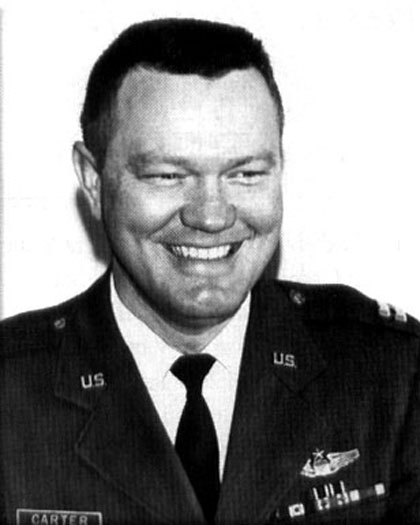
William Thomas Carter, son of Thomas and Deliah Leftwich Carter, was born in Decatur, GA. The Carters were a close-knit family and devoted members of the Baptist Church. "Bill" had even considered becoming a minister at one time. According to sister Martha, Bill was always getting into things-he once got the idea to build an entire city in the sand pile. He also enjoyed playing with lead soldiers and building model airplanes. His most devastating high school experience occurred on his first attempt to fly a powered model airplane, which crashed on landing and was totally destroyed. This turned out to be his first and last aircraft accident, although in 1982, as a passenger, he survived a terrorist bombing on a 747 that landed safely. Bill excelled in math and science and discovered his passion for music and ROTC while in high school. He attended Georgia Tech for two years, playing in the band. Bill never missed a beat in music, school, or at work and remained employed by Trust Company of Georgia until he entered West Point in 1953. Again, Bill excelled in math and engineering courses and was always willing to help those who had academic troubles. He continued his pursuit of music in the chapel choir and found a new passion: photography. He also found a combative bent for boxing. On occasional weekend visits to his classmates' homes in the New York area, parents were always impressed with Bill's charm, southern accent, and genteel ways. Bill was a good friend to those who knew him well. Although always congenial and helpful, he was known to occasionally repeat a joke. Later, his children would interrupt the repeats with, "He's telling #7 again!" After graduation in 1957, Bill was commissioned in the Air Force and married Shirley Kress. Following pilot training at Vance AFB, OK, and F-100 training at Luke and Nellis fields, he served tours in Okinawa and Myrtle Beach with some lengthy TDYs to Europe, long enough to teach short courses for American University in Incirlik. In 1964, Bill went back to school at Georgia Tech for his master's degree in aerospace engineering and, in 1966, began teaching math and glider flying at the Air Force Academy. His enthusiasm for teaching and flying was unforgettable and contagious. He wrote the Academy's soaring instruction manual and a popular book, Soaring- The Sport of Flying Sailplanes, published in 1974. He described in great detail catching the westerly winds coming off the Rockies and getting up to over 60,000 feet in altitude. A general from the Class of '70 said this about his doolie year: "When I needed help in math, CPT Carter invited me to his house and kept me going. He was so proud to be a fighter pilot and an Academy instructor. He was my inspiration to survive math and that first year. He really cared." After USAFA, Bill transitioned to the F-4 Phantom and was assigned to Southeast Asia, while Shirley and their six children moved back to New York, her home state. During the Viet Nam War, "Bushtop" Carter flew 125 combat missions in the F-4, serving in 1971 as flight commander in the 435th Tactical Fighter Squadron at Ubon. His calm nature and stubborn resolve were evident in the photographs of him counting bullet holes after a particularly bad mission. After serving his combat tour, Bill and Shirley made the difficult decision to separate while Bill continued his Air Force career. Bill started his engineering career at Robbins AFB, GA, in missiles. In his following assignment to Wright-Patterson AFB, Bill found his niche as an aerospace engineer, first with the 4950th Test Wing, then as deputy director of engineering for the F-15, and in his final assignment, as chief engineer for the B-52 Advanced System. During his distinguished Air Force career, Bill received numerous decorations and awards, including the Air Medal with ten oak leaf clusters, Air Force Commendation Medal, Meritorious Service Medal, and the Distinguished Flying Cross. After retiring in 1979, Bill became division manager for aerospace systems engineering with Veridian Corporation (now General Dynamics). He continued making major contributions in the design, integration, and test of aerospace defense systems. He was a whiz in mathematics and computer systems, inspiring those who worked with him. Regardless of the project difficulties, he always maintained that positive, "can-do" attitude and was usually the problem solver. He never boasted, never insisted on taking credit, and was always there for his friends and associates. In 1986, Bill married Nancy Edwards, and they purchased a home south of Xenia, OH, on six gently rolling acres with a stream flowing through it. Nancy brought three children to the marriage, and Bill was extremely proud of all nine children. His home hobbies seemed to expand every year. His photography lab became digitized on his home computer and he mastered the art of woodworking, consuming the minimal space left in the basement and garage. Bill worked his last 12 years in the Wright Patterson Landing Gear Test Facility, making significant contributions to full-scale research and test programs for the Air Force, Navy, and NASA. Bill's aviation and engineering career spanned 46 years of dedicated service to the Air Force and our country. Bill will be remembered as a loving father and husband, a friend who was always there, a courageous and outstanding fighter pilot who faithfully served his country with integrity and valor, a teacher who really cared, a superbly competent aerospace engineer, and a selfless leader of those who had the good fortune to serve under him. He will be remembered often and commended always for honoring his lifelong commitment to "Duty, Honor, Country." Bill's wife, Nancy; nine children; five grandchildren; one sister; three nieces; and a nephew, all of whom he loved dearly, survive him. J.J. Dale, USAFA '63 |