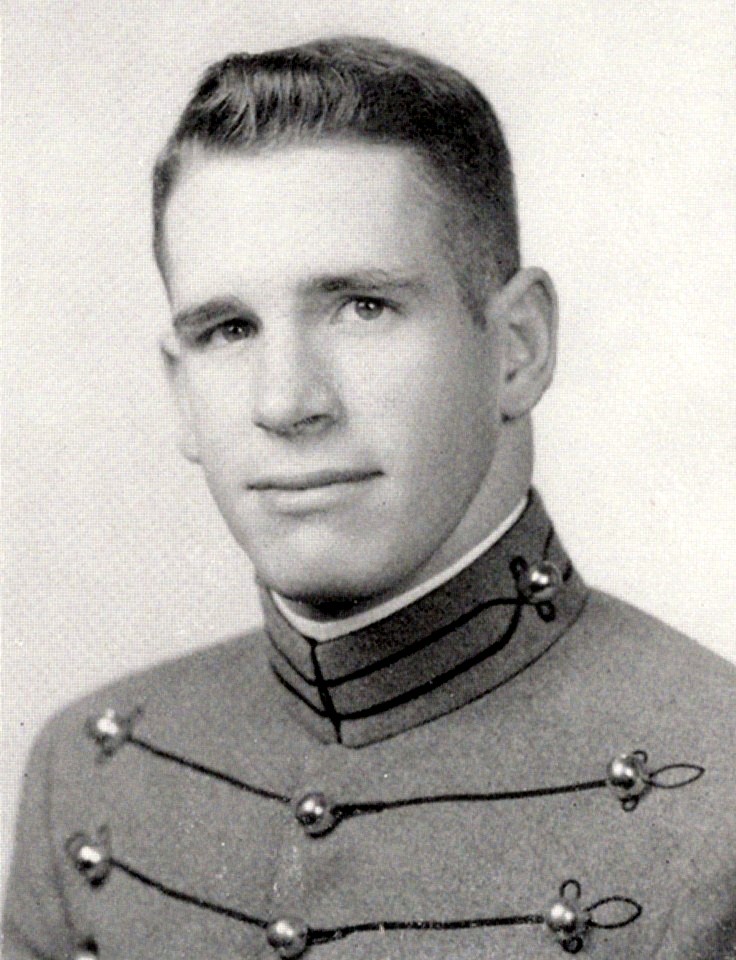
If you had asked Howell Hopson Jordan, Jr., how he would like to be remembered, he would have said, "as a man of honor." And so he is. Hal's grandfather graduated with the Class of 1903, his father with the Class of '27, and two uncles with the Classes of '29 and '38. Born in Hawaii, Hal lived in Orlando, FL, while his father served in the Pacific. Later, his father joined MacArthur s staff, and the family was reunited in Japan. Hal attended the Tokyo American School until 1948 and then attended one year of high school at Washington and Lee in Arlington, VA, and two years at College Park High School near Ft. McPherson, GA. The family then moved to Italy. In high school, Hal excelled in football and basketball and was a member of the National Honor Society. After one unchallenging semester in Italy, however, in a 15-student school with no athletic program, he returned alone to College Park and lived with his high school football coach and his wife. Renewing relationships he would honor all his life, Hal was president of his class. The Atlanta Journal Constitution designated him the best all-around student and placed him on the composite All-Atlanta and the All-Regional football teams. A high school teammate, Joe Bishop, also a West Point classmate, was killed in Viet Nam. Hal saw to it that Joe's wife and high school sweetheart, Patty, and her children were included in all West Point Society functions. When Hal's football coach died, Hal came halfway across the country to honor him and help his family. "Duty" and "Honor" were applied concepts for him. Hal's success continued at West Point. Achieving academically, he was also a Sunday School teacher for the high school children on post and eventually became the High School Department Director. His greatest source of pride from his cadet years was serving as F-2 s Honor Representative, and as the investigative officer of the Honor Committee. During his First Class year, he commanded Company F-2. He also played "B" Squad football. At graduation Hal ranked 12th militarily and was commissioned into the Infantry the year his father retired from active service, passing the soldier tradition from father to son. After Ranger School at Ft. Benning, GA, Hal served in Germany, earning the Army Commendation Medal, a particular accomplishment for an officer on his first assignment. There, in 1959 he was named Head Coach of the Year, 2d Place Football Team, U.S. Army Europe. He then returned to Ft. Benning to serve as an instructor at the Ranger School jungle training camp, a prestigious assignment commemorated by a brick along the Ranger Walk at Ft. Benning, recognizing Hal's professional contributions to the students and the school. By 1963, Hal was stationed near Seoul, Korea, with the 7th Division. After one year of his tour, he was diagnosed with malignant melanoma on the back of his neck. Medically evacuated to Walter Reed and assisted by his father, he obtained opinions from the country's best medical sources. Surgery at Walter Reed removed a large section surrounding the melanoma, but Hal was told that, if the melanoma returned, it would quickly metastasize and become fatal. Hal did not share this information, even with his closest friends. He chose to live, work, and succeed on the basis of his performance, not on sympathy. Returning to duty, Hal earned a master's degree in English from Columbia before teaching in the English Department at West Point. Afterwards, in 1968, he served with the 4th Division in Viet Nam. For the next 10 years, Hal lived the only life he wanted: that of a professional Army officer, on the move, serving his country, building communities, and always the gentleman, kind and considerate of others. Hal earned an MBA at Georgia State in Atlanta and ran and finished the New York City Marathon. In Seoul, he started the first Korean Civitan Club. In all his assignments, he actively promoted the Civitan community service clubs. In 1973 he was the vice president of the Civitan Club of Atlanta before serving as lieutenant governor of the Civitan Club of Korea in 1974. From 1976-77, he served as vice president and then president of the Civitan Club of Brooklyn. In 1978, Hal retired and began an entrepreneurial career as a factory representative for a young furniture company in New England that needed an aggressive self-starter to develop a Southern market. For the next 10 years, Hal ran his wholesale furnishings business, a good profession for a man who considered the world his hometown. He also earned a real estate license and bought and sold homes. He opened a retail shop in Florida, featuring, among other things, his mother's artwork Atlanta became the focus of Hal's life, and there he met Susan Selfridge and her two charming daughters—the kind of family a man looked forward to seeing at the end of the day. He and Susan arranged to be married, and he moved his scattered "worldly possessions" to Atlanta. It was truly a Permanent Change of Station. In early July 1992, while visiting his father, Hal had a medical checkup resulting in an overnight hospital stay. The melanoma had returned, 29 years after the initial episode. After investigating his limited options, Hal gained admittance to the experimental Biological Response Modification Program at the National Institutes of Health in Frederick, MD. First, Hal visited Susan and her daughters in Atlanta and then his sister Gladys, brother-in-law Red Seaward, and his mother, in Springfield, VA From there, known only to his family and fiancée, he drove to Frederick, where he was regularly visited by Gladys and Red, to begin a series of grueling treatments to boost his immune system. Between treatments, Hal divided his time between Atlanta and Springfield. In late August, after a short visit to Atlanta and Springfield, he returned to the hospital. Less than a week later, with Gladys and Susan at his side, Hal requested all life support systems be disengaged. Quietly and quickly, he took his place in the Long Gray Line. Hal left us in a manner typical of the way he lived his life—with dignity and courage. West Point was his heart, the Army was his family, and the world was his home. Bob Faulkender '57
|