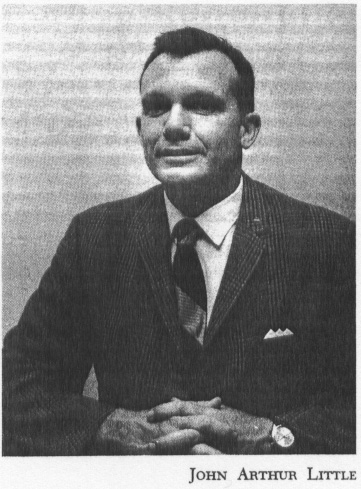
John was born in New York on 12 December 1935, of a Canadian mother and an American father, both of British origin. His father was employed by an oil company in Venezuela, so John spent his childhood in South America, where he later returned during vacations because he so loved the country, the outings on horseback, and the long marches across the jungle where he worked as a lineman and instrument man in survey crews. His parents sent him to military schools in Florida and Georgia. He went to Georgia Military Academy where he received a Cold Key for scholarship. At eighteen John was accepted for entrance to the United States Military and Naval Academies. Placed twenty-fifth out of five thousand, he won a United States Coast Guard Academy position. He chose West Point where he spent some of his happiest years. He graduated in 1957. After his training at Fort Knox and Fort Benning he attended the Competitive Marksmanship School and took part in National Rifle and Pistol matches at Camp Perry, Ohio, in 1958; taught demolitions to recruits at Fort Meade, Maryland, in 1959. Subsequently he attended Purdue University where he received a Master's Degree in Engineering Science in 1961. Then, John returned to West Point and was promoted to Captain. Instructor of Ballistics, Assistant Professor in charge of individual research projects, Supervisor in a fully instrumented Theoretical Ballistics Laboratory, he also took pilot training, and was elected president of the West Point Flying Club. In 1964 John left the Army to devote himself to teaching and flying. Pursuing both of these activities, even combining them, he became an accomplished Flight Instructor. On the faculty at several colleges and universities, he taught mathematics, physics, chemistry, computer sciences, meteorology and aeronautical science, while continuing his study and research. In 1971 he was admitted to Purdue University's doctoral program in Operational Research. An experienced pilot, he applied to the National Aeronautics and Space Agency for Space Flight Training in 1965. Only thirty percent of the applicants were admitted and John was one of them, although he was not ultimately selected for final training in the space program. In 1968 he was named Regional Director of Caribbean Airlines in San Juan, Puerto Rico. In 1969 he became Chief Flight Instructor and pilot for Monmouth Airlines, New Jersey. Having obtained an Airline Transport Rating, a commercial pilot license, and being a Federal Aviation structor, John was qualified to fly eighty-seven types of aircraft, among them the P.A.31 Turbo Navajo, the Lockheed T33, the Beech 99, the DC-3 and hydroplanes, on which he accumulated 3,400 hours of flying time. He was also a Flight Instructor and Course Supervisor for Aircraft Owner's and Pilot's Association nationwide weekend clinics. In 1971 he resumed sky diving and became president of the sky diving club of Indiana State University in Terre Haute. But John was not only a scientist and a pilot; he published poems and short stories in several magazines, he liked to draw, was gifted in music, and loved languages. He spoke Spanish fluently and served as president of the Spanish club of Terre Haute; he learned French on his own, studied Russian and Icelandic and was also interested in Chinese. By a previous marriage he had three children: John, Jennifer and Christofer, whom lie loved very much. On 29 April 1971 he acquired a new passion: his newborn daughter Marie-Noelle. It was within his family, among his students, or at the tranquil family residence in the village of Hardiness, in the Mayan region of France where John spent his last vacation that he rediscovered that freedom of spirit and inner peace which he had always experienced at the controls of an aircraft, high above the worries and petty problems of daily life. Hospitalized 2 February 1972, John died forty-eight hours later of a cerebral hemorrhage, A very simple service reunited his colleagues and students at his parish church in Terre Haute. His classmates and superiors rendered him the final honors in an interment ceremony at the West Point Cemetery, where he now rests. On 14 May 1972 Marie-Noelle welcomed a little sister, Karine. - The Family
|